Two Bills, Not One: What Tallahassee Did to Local Zoning
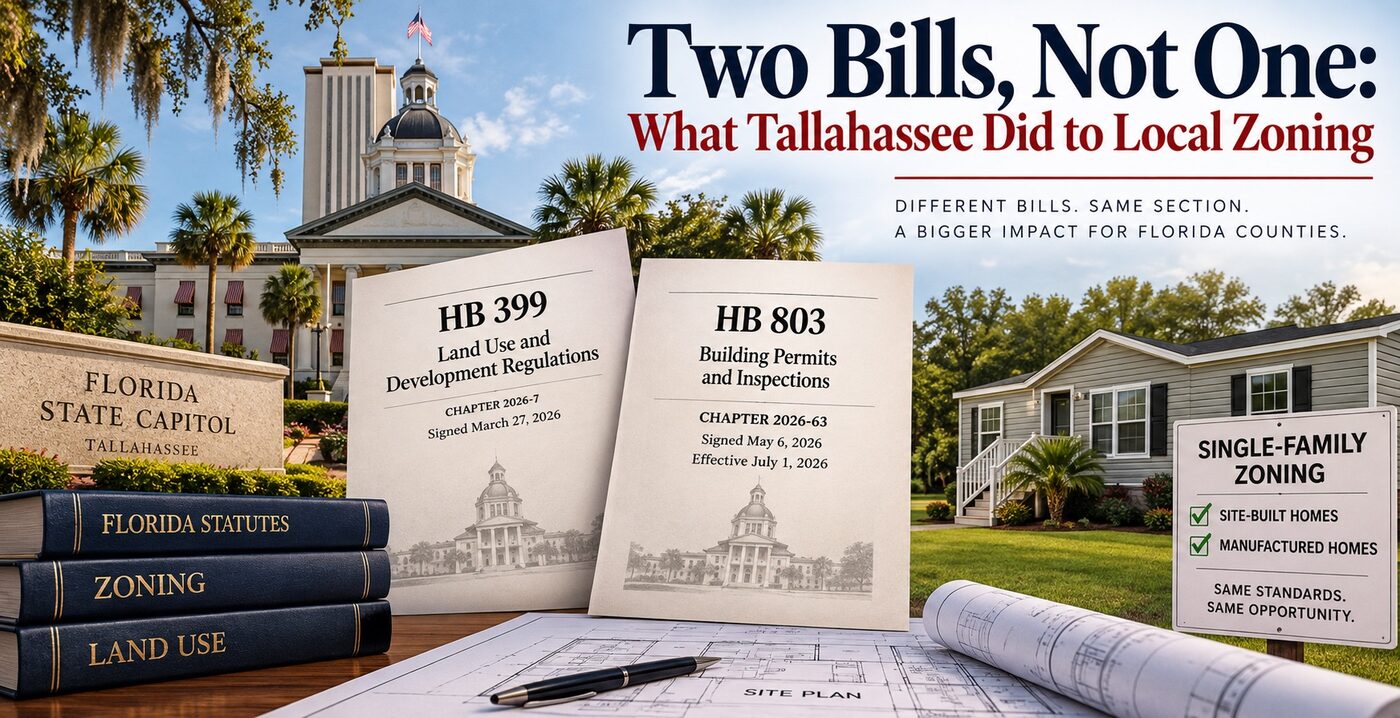
Local discussion of Florida's 2026 land use changes has settled on House Bill 803. That is understandable, since HB 803 touches building permits and permits are what people deal with. But it leaves out most of the story. The bill that reshapes how Florida counties review development is House Bill 399, and the provision people are actually arguing about sits in both.
HB 399, titled Land Use and Development Regulations, received final House approval 73 to 27 and was approved by the Governor on March 27, becoming Chapter 2026-7. It requires development permit application fees to be tied to the actual cost of review rather than a percentage of construction cost or project valuation. It requires every comprehensive plan and land development code to include factors for assessing residential compatibility. And it creates a new section of law, 553.385, requiring zoning parity for off-site constructed residential dwellings.
HB 803, titled Building Permits and Inspections, was approved May 6, becoming Chapter 2026-63, and took effect July 1. It is a permitting bill: permit expiration, standardized applications, homeowners association review. It also exempts an owner or the owner's contractor from needing a permit for work valued under $7,500, subject to a written exemption request and documentation of the work and value, and excluding work in a flood hazard area and electrical, plumbing, structural, mechanical or gas work.
HB 803 also created its own version of section 553.385.
The $7,500 exemption is worth a closer look, because it is reported as broader than it is. Section 553.79(1)(g) requires a local government to exempt an owner of a single-family dwelling, or the owner's contractor, from obtaining a building permit for work valued under $7,500. It then removes most of it. The exemption does not apply on property partially or entirely in a flood hazard area, and does not apply to any electrical, plumbing, structural, mechanical or gas work. A project may not be divided to evade the threshold. To qualify, the owner or contractor must submit a written request to the local enforcement agency with a copy of the contract or other documentation showing the nature and value of the work. And the local government has no legal duty to the owner, the contractor, or their successors for exempted work. No permit, no inspection, no recourse.
That is the part worth knowing. Two bills in the same session created the same section of the Florida Statutes. The Legislature's own publication says so, carrying a note on multiple acts affecting a single provision and reproducing the second version in full.
So reading HB 399 alone gives you only half the answer. Its version was scheduled for January 1, 2027, but HB 803 separately enacted section 553.385 effective July 1, 2026. The parity requirement is already in effect.
What the section requires is short. An off-site constructed residential dwelling must be permitted as of right in any zoning district where single-family detached dwellings are allowed. A local government may not treat it differently or more restrictively than a site-built home in the same district, and may not regulate it based solely on the method of construction, the location of construction, or the presence of components built off site. Any ordinance that has the effect of excluding these homes is void and unenforceable.
Local government keeps real authority. It can still apply architectural, design, setback, height and bulk standards, provided they apply uniformly to every single-family dwelling in the district. It can adopt compatibility standards covering roof pitch, minimum square footage of livable space, exterior finishing materials, foundation enclosure, attached structures, and setbacks, lot dimensions and orientation. That is not nothing. It is simply no longer a veto.
Which brings me to a claim I keep seeing: that a manufactured home qualifies only if it is permanently attached to the ground on a concrete slab, and is therefore not really mobile.
That is not what the statutes say.
A manufactured home under section 320.01(2)(b) is a mobile home built after June 15, 1976 in an off-site facility to the federal construction and safety standard. A mobile home under section 320.01(2)(a) is built on an integral chassis. The chassis stays. Section 320.015 draws the line expressly, distinguishing a mobile home from a prefabricated or modular unit not manufactured upon an integral chassis or undercarriage for travel over the highways. And section 320.01 tells the tax collector to measure the home's length from the wall nearest the drawbar and coupling mechanism, and says that if the owner cannot prove the hitch length, four feet may be assumed. The Legislature wrote the hitch into the measuring instructions.
As for permanently affixed, section 193.075 defines it in one sentence: a mobile home is considered permanently affixed if it is tied down and connected to the normal and usual utilities. Tied down and hooked up. That is the whole test. Not a slab, not a poured foundation, not the removal of anything.
The phrase the new law actually uses is treated as real property, and that is a tax and title status, not a construction method. When the owner owns the land and the home is permanently affixed, Florida law treats the mobile home as real property for taxation, and an RP series sticker is issued. That satisfies the real property component of section 553.385.
Reasonable people can conclude the Legislature went too far in taking zoning discretion away from counties, and that argument is worth having. But it should be had over what the law says.
What it says is that as of July 1, and beyond argument by January 1, a Florida county cannot keep a HUD-code manufactured home out of a single-family district because of how it was built. It can regulate roof pitch. It cannot exclude the home because it was built in a factory. That is coming to Citrus County, and to every county in the state.
Sources for verification
- Ch. 2026-7, Laws of Florida (CS/CS/CS/HB 399), approved March 27, 2026.
- Ch. 2026-63, Laws of Florida (CS/CS/HB 803), approved May 6, 2026, effective July 1, 2026.
- Fla. Stat. s. 553.385, including the statutory note describing both versions created in the 2026 session.
- Fla. Stat. s. 553.382, history note citing s. 7, ch. 2026-7 and s. 5, ch. 2026-63.
- Fla. Stat. s. 553.79(1)(g), building permit exemption for work under $7,500.
- Fla. Stat. s. 320.01(2)(a) and (2)(b), definitions of mobile home and manufactured home.
- Fla. Stat. s. 320.015, taxation of mobile homes and the integral chassis distinction.
- Fla. Stat. s. 193.075(1), definition of permanently affixed and the RP series sticker.