The County Attorney's Email, the County Code, and What the New Law Actually Says
This morning the Chronicle ran my column on House Bills 399 and 803 and the changes they made to Florida law governing off-site constructed residential dwellings. A longer version has been on my site since Tuesday.
Since then I read a post that included a September 11 email from Citrus County Attorney Denise Dymond Lyn concerning the same law. Having read both the post and the email, I think there is enough ambiguity in each that some clarification is warranted.
One thing first. I develop land in Citrus County, and section 553.385 applies to property I own. Read what follows with that in mind, and check the citations. Every document referenced here is a public record.
Where the County Attorney is right
Florida's new law does not mean someone can place a manufactured home anywhere they want. It does not authorize manufactured homes in every commercial, industrial or other zoning district. If someone is claiming these homes can now be placed in "any existing land use category," that is too broad, and she is right to say so.
It also matters what kind of home we are discussing. Section 553.385 does not say that every structure commonly called a mobile home qualifies. It incorporates a manufactured home as defined in section 320.01(2)(b), constructed wholly or partly off site and treated as real property. Section 320.01(2)(b) means built after June 15, 1976 to the federal construction and safety standard. The section also covers qualifying manufactured buildings intended for single-family residential use.
So rather than argue over terminology, we should use the definition the Legislature gave us.
But that is not the test the Legislature wrote
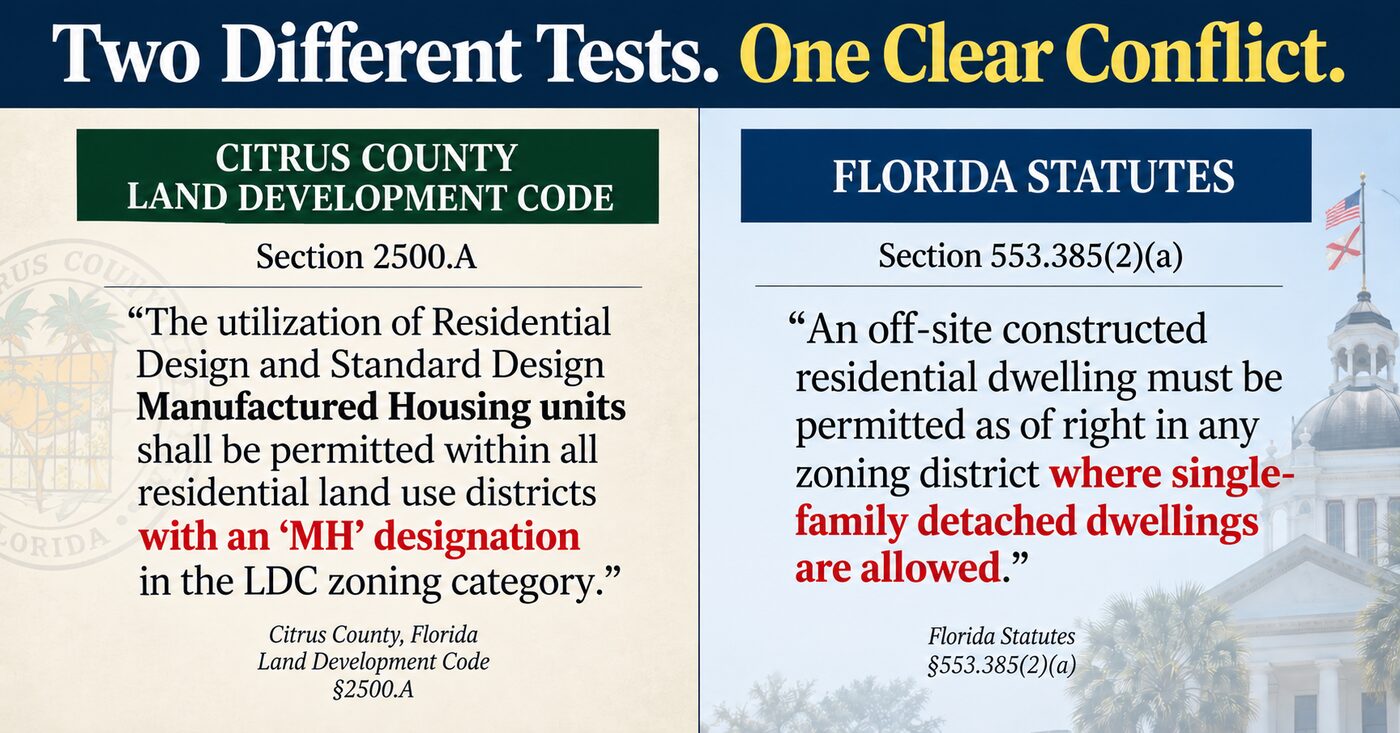
Section 553.385(2)(a) says an off-site constructed residential dwelling "must be permitted as of right in any zoning district where single-family detached dwellings are allowed."
That distinction is the heart of this issue. The question is not whether a manufactured home can go anywhere. The question is whether the zoning district allows detached single-family dwellings. If it does, a qualifying off-site constructed residential dwelling must be permitted as of right.
This is also why I think the post accompanying the email goes too far. It characterizes her position as saying manufactured homes are not allowed in any single-family home district. That is not what her email says. Her email addresses claims that mobile homes can be placed in "any existing land use category."
Those are very different statements, and the difference is not a technicality. "Any zoning district where single-family detached dwellings are allowed" is the Legislature's own language.
Did the law really change nothing?
The post states that the new law did not change anything and merely codified existing case law and statutory authority. That deserves closer examination, because it is partly true and the part that is not true is the part that matters.
Florida already had section 553.38. It reserves substantial local authority over land use, zoning, setbacks, site development and architectural and aesthetic requirements, while requiring those rules to be reasonably and uniformly applied to conventionally constructed and manufactured buildings.
Florida law also already regulated local treatment of HUD-code manufactured homes. Section 320.8285(6) reserved substantial zoning and land use authority to local jurisdictions while imposing its own uniformity requirements.
So the idea that there was no law governing local treatment of manufactured housing before 2026 would be wrong.
But neither statute contained the rule the Legislature enacted this year: a qualifying off-site constructed residential dwelling "must be permitted as of right in any zoning district where single-family detached dwellings are allowed."
What section 320.8285(6) did not say was that a manufactured home must be permitted as of right in every zoning district where a detached single-family dwelling is allowed. Section 553.385 now says exactly that.
Section 553.385 also expressly accounts for that existing framework. Subsection (3) references section 553.38 while prohibiting local ordinances that conflict with either section or have the effect of excluding qualifying off-site constructed dwellings. The Legislature knew the older statute was there and wrote the new one to sit alongside it.
Section 553.385 further prohibits different or more restrictive treatment, bars regulations having the effect of exclusion, limits compatibility standards, and declares conflicting regulations void and unenforceable. That is why saying the new law changed nothing goes too far.
The County still has authority, but it has limits
The County Attorney correctly points out that local governments retain authority over architectural and aesthetic standards. Section 553.385 preserves that authority and then bounds it. Generally applicable design, setback, height and bulk standards must be applied uniformly to all single-family dwellings in the district. Compatibility standards must be reasonable, cannot have the effect of excluding off-site constructed dwellings, and must apply equally to site-built homes.
The Legislature limited those compatibility standards to six areas: roof pitch, minimum square footage of livable space, type and quality of exterior finishing materials, foundation enclosure, existence and type of attached structures, and setbacks with lot dimensions and orientation.
The County can establish legitimate compatibility standards. What it cannot do is create one set of standards for a qualifying manufactured home and a different set for a site-built home in the same zoning district. Subsection (4) makes the point again: local regulations must be reasonable and uniformly enforced "without distinction as to housing type."
Where the County's own code comes in
Now compare the new state law with Citrus County's existing Land Development Code.
Chapter 2, section 2500.A says this:
"The utilization of Residential Design and Standard Design Manufactured Housing units shall be permitted within all residential land use districts with an 'MH' designation in the LDC zoning category."
That is the County's test. Manufactured housing is permitted where the zoning category carries an MH designation.
Citrus County lists Single Family as a permitted use in seven residential districts: CL, RUR, CLR, CRR, LDR, MDR and HDR. On its face, section 2500.A permits manufactured housing within the MH-designated subset of those districts. Section 553.385(2)(a), on its face, asks a different question: whether the district allows single-family detached dwellings.
Two different tests, applied to the same parcels, producing different answers.
The Legislature addressed that situation directly. Section 553.385(2)(b) says a local government may not adopt or enforce a zoning, land use or development regulation that treats a qualifying off-site constructed dwelling "differently or more restrictively" than a site-built single-family dwelling allowed in the same zoning district.
Subsection (3) goes further. A local government may not adopt or enforce an ordinance, regulation or policy that conflicts with section 553.385 or section 553.38, or that has the effect of excluding off-site constructed residential dwellings. Any such ordinance is "void and unenforceable" as applied to those dwellings.
That provision cannot be read out of the statute. If the Legislature intended every existing local restriction to keep operating exactly as before, there was little purpose in expressly declaring conflicting and exclusionary ordinances void.
One timing detail, and I want to be careful how I put it. The version of Chapter 2 now in force was adopted by Ordinance OA-2026-A16 on June 22, 2026. Section 553.385 took effect July 1. Ordinances are drafted months ahead and June 22 was almost certainly too late to change course, so I read nothing into it beyond the calendar. But it frames the question. If the new law changed nothing, the MH-designation restriction readopted nine days earlier continues operating as written, which raises the obvious question of what work the Legislature intended the new "as of right" and "void and unenforceable" provisions to do. If the law did change the governing test, Chapter 2 needs review.
The email itself points toward the answer. It notes that the County "has not considered whether it wishes to adopt an ordinance incorporating these architectural and aesthetic criteria." Those criteria now define the specific compatibility standards the Legislature permits local governments to apply under section 553.385.
The County cannot rewrite the ordinance to reach the same result
This point matters as much as the first one.
The answer is not to replace a prohibition on manufactured homes with architectural requirements designed to produce the same exclusion. The statute anticipated that. Compatibility standards cannot have the effect of excluding qualifying off-site constructed dwellings, and they must apply equally to site-built homes.
If the County adopts a roof pitch, a minimum square footage or an exterior material requirement, it cannot impose it only on manufactured homes while allowing site-built homes in the same district to avoid it.
The County can regulate the house. It cannot regulate it differently simply because it was manufactured off site.
This does not change density
One final distinction, because it is the source of most of the local alarm.
Nothing in section 553.385 increases the residential density allowed on a property. If the zoning allows one detached single-family dwelling on a lot, the statute does not authorize four manufactured homes on it. Low Density Residential remains low density. Medium Density Residential remains medium density.
The issue is not density. It is housing type.
There is a simple way to settle this
Citrus County can review its Land Development Code against section 553.385 and amend what no longer conforms. That is ordinary housekeeping and it happens after every session.
If reasonable lawyers disagree about how the two interact, there is a second option. Under section 16.01(3), Florida Statutes, an officer of a county may request an official written opinion from the Attorney General on a question of law relating to that officer's official duties.
Either route beats settling this in social media posts, or eventually in a courtroom at considerably greater expense.
The Legislature gave us a direct test. If single-family detached dwellings are allowed in the zoning district, a qualifying off-site constructed residential dwelling must be permitted as of right. The County still controls density and retains real authority over uniformly applied standards. Whether it can exclude a qualifying manufactured home from a district where it already allows a site-built detached home is a different question, and on that one section 553.385 is difficult to read any other way.
Sources for verification
- Email, Denise A. Dymond Lyn to Commissioner Rebecca Bays and county staff, subject “RE: Section 553.385 – Manufactured Homes, Zoning and Permitting,” September 11, 2026.
- Fla. Stat. s. 553.385 (2026), both versions, created by s. 8, ch. 2026-7 (HB 399) and s. 6, ch. 2026-63 (HB 803).
- Fla. Stat. s. 553.385(1)(b), definition of off-site constructed residential dwelling; s. 553.36; s. 320.01(2)(b).
- Fla. Stat. s. 553.385(2)(a), permitted as of right in any zoning district where single-family detached dwellings are allowed.
- Fla. Stat. s. 553.385(2)(b), no different or more restrictive treatment than a site-built dwelling in the same district.
- Fla. Stat. s. 553.385(2)(c) and (2)(d), uniform standards and the six permitted compatibility criteria.
- Fla. Stat. s. 553.385(3), which expressly references s. 553.38 and declares conflicting or exclusionary ordinances void and unenforceable; s. 553.385(4), uniform enforcement without distinction as to housing type.
- Fla. Stat. s. 553.38, local authority reserved, and uniform treatment of conventionally constructed and manufactured buildings.
- Fla. Stat. s. 320.8285(6), local zoning and land use authority reserved, with uniformity requirements for manufactured homes.
- Citrus County Land Development Code, Chapter 2, Land Use Districts, s. 2500.A, adopted by Ordinance OA-2026-A16, June 22, 2026.
- Citrus County Land Development Code, Chapter 2, district use tables at ss. 2401 (CL), 2402 (RUR), 2403 (CLR), 2404 (CRR), 2405 (LDR), 2406 (MDR) and 2407 (HDR), each listing Single Family as a permitted use.
- Fla. Stat. s. 16.01(3), who may request an opinion of the Attorney General.