Zoning Was Half the Problem. The Other Half Was Money.
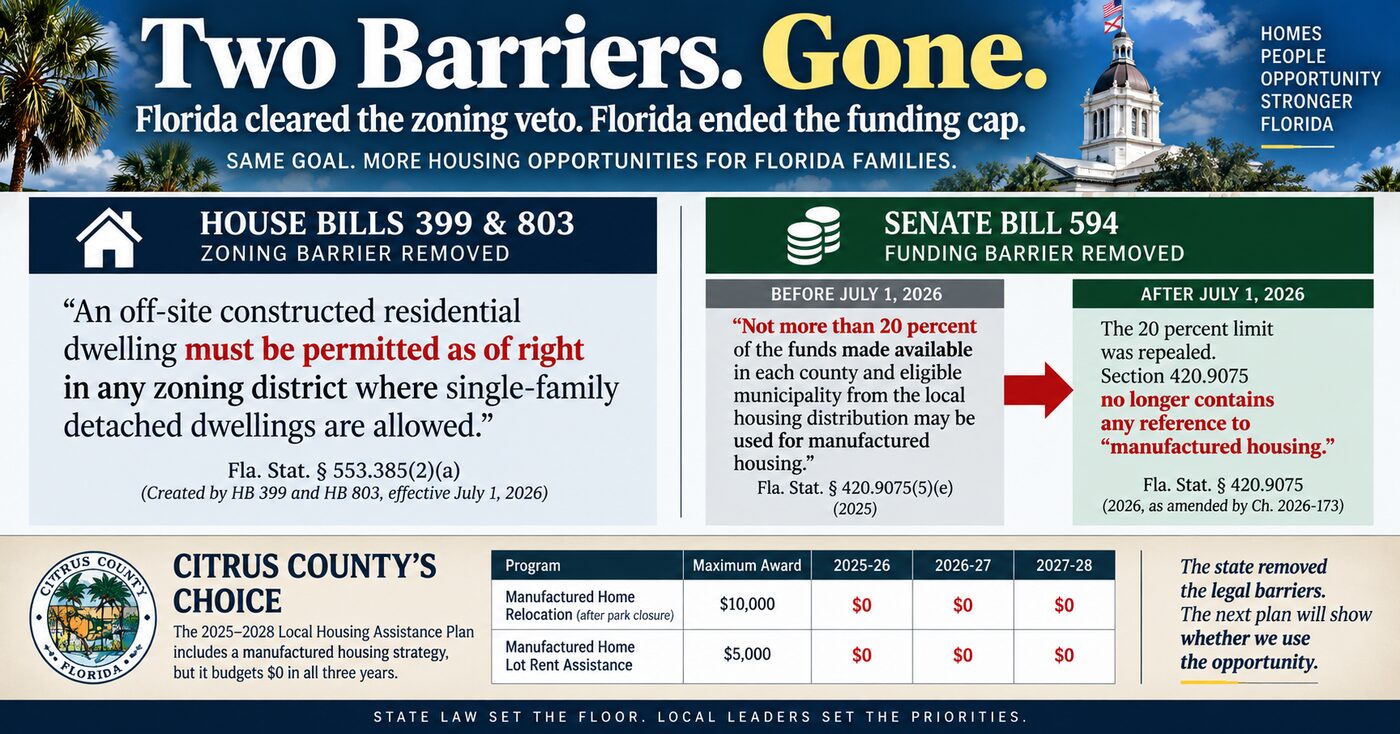
Last week I wrote about two bills that created the same section of the Florida Statutes, and about what the law actually requires when a county reviews a factory-built home. That piece was about permission: whether a county can say no.
This one is about money, and it is the half nobody covered.
Senate Bill 594 passed the Senate 39 to 0 and the House 110 to 0. The Governor approved it on June 26, it became Chapter 2026-173, and it took effect July 1. Read the title and it looks like housekeeping: Local Housing Assistance Plans.
Most of it is exactly what it appears to be. It is a lot rent bill. It requires every county and city to include a strategy in its local housing assistance plan for mobile home owners, and that strategy must include lot rental assistance. It caps that assistance at six months' rent. It lets SHIP dollars pay for rehabilitation and emergency repairs on mobile homes. If you live in a park and your lot rent has been climbing, that is the part written for you, and it deserves more attention than it has received.
But the bill did something else. The Senate staff analysis of the bill as filed does not mention it at all. That analysis lists three things: lot rental assistance, the plan requirement, and a conforming cross-reference. Whoever reads only that document will miss the provision that matters most to housing supply.
Here is what Florida law said before July 1, at section 420.9075(5)(e):
"Not more than 20 percent of the funds made available in each county and eligible municipality from the local housing distribution may be used for manufactured housing."
Here is what it says now. Nothing. The subsection is gone. Search the current text of section 420.9075 for the phrase "manufactured housing" and you will not find it anywhere in the section. What used to be paragraph (f) moved up to take its place. The history note at the foot of the statute ends with s. 2, ch. 2026-173.
SHIP is the State Housing Initiatives Partnership, the program that distributes state housing dollars to every county in Florida. Under prior law a county could put no more than one dollar in five of that money toward manufactured housing. That ceiling no longer exists.
So put the session together. Within a few months the Legislature removed the zoning barrier, meaning a county can no longer exclude a factory-built home from a district where site-built homes are allowed, and removed the funding barrier, meaning a county can no longer be told it has reached its manufactured housing limit. Two separate obstacles, both cleared, and I have yet to see anyone connect them.
Now the local part, which is not the story I expected to write.
Citrus County's housing assistance plan runs from 2025 through 2028 and anticipates roughly $1.24 million a year in SHIP funds. The plan does contain a manufactured housing strategy. It is listed in the table of contents, it carries program codes, and it sets maximum awards of $10,000 for relocation after a park closure and $5,000 for lot rent.
The county's own Housing Delivery Goals Chart budgets that strategy at zero dollars and zero units. In all three years.
The twenty percent cap was never Citrus County's constraint. You cannot be held back by a ceiling you are not standing near. The county budgeted $600,000 a year to new construction, thirty units, routed through non-profit developers selling to first-time homebuyers. Manufactured housing received a line on the page and nothing in the column.
That is a local choice. It was not made in Tallahassee and it cannot be corrected there.
To be fair to the county, its plan gets something right that a great many people still get wrong. Mobile homes built after June 1994 are eligible for owner-occupied rehabilitation, emergency repair and disaster assistance, on one condition: the home must be classified as real property. That is the same test I wrote about last week. Under section 193.075, a mobile home is permanently affixed, and therefore real property, when it is tied down and connected to the normal and usual utilities. Not a slab. Tied down and hooked up. Citrus County's housing office has been applying the correct standard for years, whatever is being argued about it elsewhere.
So here is where matters stand. The state spent a session clearing obstacles from the path of factory-built housing. It ended the zoning veto in July and it ended the funding ceiling in July. What it cannot do is compel a county to spend a dollar it has chosen not to budget.
The next local housing assistance plan is the document to watch. The ceiling is gone. The remaining question is whether anyone in Citrus County uses the room it opened.
Sources for verification
- Ch. 2026-173, Laws of Florida (CS/CS/SB 594), Local Housing Assistance Plans, approved June 26, 2026, effective July 1, 2026. Senate 39-0, House 110-0.
- Fla. Stat. s. 420.9075 (2025), subsection (5)(e), the twenty percent manufactured housing limit, since repealed.
- Fla. Stat. s. 420.9075 (2026), current text, and the history note citing s. 2, ch. 2026-173.
- Fla. Stat. s. 420.9075(3)(i), (5)(a) and (5)(c), the mobile home strategy, lot rental assistance and rehabilitation provisions.
- Fla. Stat. s. 420.9072(7)(b)3., lot rental assistance not to exceed six months' rent.
- Florida Senate staff analysis, SB 594, Effect of Proposed Changes, which does not address the repeal of the twenty percent limit.
- Citrus County, Florida, SHIP Local Housing Assistance Plan, fiscal years 2025-2026 through 2027-2028, Florida Housing Finance Corporation.
- Citrus County Housing Delivery Goals Charts for 2025-2026, 2026-2027 and 2027-2028, manufactured housing line.
- Fla. Stat. s. 193.075(1), definition of permanently affixed.