The Discount Citrus County Already Offers, and Almost Nobody Can Use
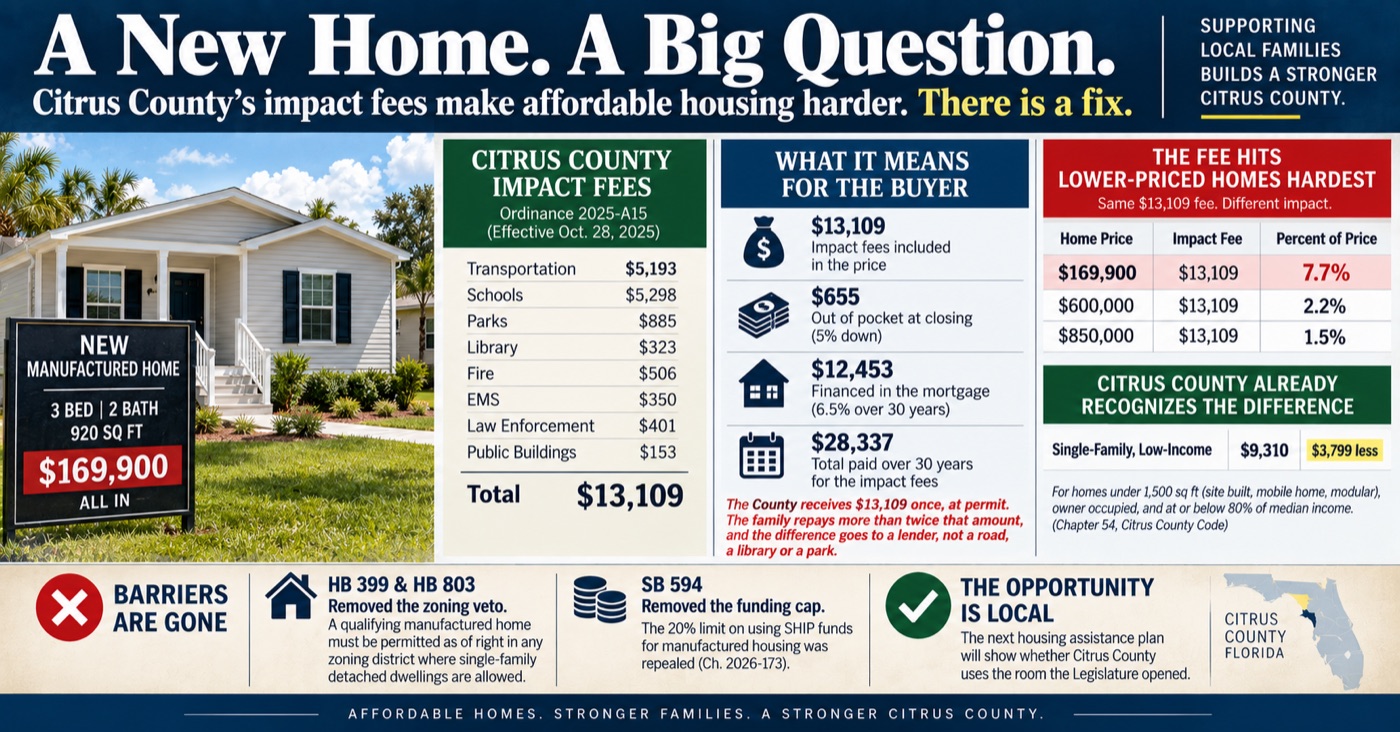
You can buy a new 920 square foot, three bedroom, two bath manufactured home in Citrus County today, titled as real property, for about $169,900 all in. In this market that is a genuinely good number, and it is one of the last paths to a new home under $200,000 anywhere in this state.
Inside that price sits $13,109 of county impact fees.
That is the rate for a single-family detached dwelling under Ordinance 2025-A15, effective October 28, 2025. Transportation $5,193. Schools $5,298. Then parks, library, fire, EMS, law enforcement and public buildings. It is due in one payment at building permit, long before anyone sleeps a night in the house.
Let me be clear about what this is not. It is not an argument that impact fees are wrong. New growth should pay its proportionate share. That is settled in Florida case law and in statute and I have never argued otherwise. This is narrower, and it is mostly about timing.
Start with what the fee does to the buyer, because it is not what most people assume.
A buyer never writes a cheque for $13,109. The fee is inside the price and the price is financed. At five percent down, about $655 comes out of their cash at closing and $12,453 goes onto the mortgage, where at six and a half percent it repays about $28,337 over thirty years.
The county receives $13,109 once, at permit. The family spends thirty years repaying more than twice that for it, and the difference does not go to a road or a library. It goes to a lender.
Note also who it falls hardest on. The fee is a flat $13,109 on every single-family house, whatever the house costs. On this home that is 7.7 percent of the price. On a $600,000 house it is 2.2 percent, and on an $850,000 house, 1.5 percent. A flat charge against a variable price is regressive by construction, and nobody has to intend it for it to be true.
The county already knows this. That is the part worth understanding.
Look at the same fee schedule, three lines below the standard rate: "Single-Family, Low-Income," $9,310. Citrus County has already decided that a modest owner-occupied home should pay $3,799 less, and has already written the number into the ordinance. The principle is not in dispute here. It was argued, decided and adopted.
So why does almost nobody get it?
Go to the definition in Chapter 54 of the county code. Low income means a home with less than 1,500 square feet of living area, and the ordinance is refreshingly plain that it means what it says: "site built, mobile home, modular, etc." It also requires the housing to be owner occupied, and the household to be at or below eighty percent of median income as HUD defines it, adjusted for family size.
That 920 square foot house passes the size test with room to spare. It is exactly the product the definition describes.
The problem is when the test is applied.
The fee is due at building permit. The discount turns on the buyer's income. On a home built on spec there is no buyer at permit. There is no household, no family size, no income to certify and nobody to certify it. So the builder pays $13,109, prices the house accordingly, and the discount that the county adopted specifically for this kind of housing goes unclaimed.
It works for a custom build where a contract is signed before the slab. It fails for production housing, which is the only thing that delivers homes at volume. The county wrote a discount for affordable houses and then attached it to a moment when nobody knows whether the house will be affordable to whoever buys it.
That is a timing defect, not a policy disagreement. And timing defects have fixes.
The fix is a voucher, and the design matters more than the idea.
A qualified buyer applies to the county and receives a certificate. At closing, the certificate is applied against the purchase price and the county settles the fee. Nothing in the fee schedule changes. The rate stays adopted at $13,109. Nothing is suspended, so nothing has to be reinstated, and the eligibility test lands at the one moment when the buyer actually exists and their income can be verified.
That the schedule never changes also avoids a trap. Section 163.31801 lets a county suspend a fee immediately, then caps increases hard, and says nothing at all about reinstatement. A county that suspends to zero may find that switching the fee back on is an increase from a rate of zero. A question for the county attorney, and a good reason to prefer an instrument that leaves the schedule alone.
The state has already cleared the way for the spending. Section 163.31801(11) says a county "may provide an exception or waiver for an impact fee for the development or construction of housing that is affordable," and then adds the part that gets overlooked: if it does, the county "is not required to use any revenues to offset the impact." No backfill required. The usual objection, that waiving a fee means finding the money somewhere else, is not what the statute says.
There is a real objection, though, and it deserves a straight answer rather than a dismissal. It is that the builder will simply keep the money. Hand out a certificate and the sticker price will not fall by thirteen thousand dollars, and the public will have bought somebody a margin.
That objection is not foolish. It is the standard economics of any demand-side subsidy: where supply cannot respond, the subsidy is bid into the price and the seller captures it. It is the same critique economists level at housing vouchers and at student lending. Anyone proposing a program like this who waves it away has not thought about it.
So answer it in the design.
Make the certificate belong to the buyer and make it portable, good with any participating builder. If the buyer can walk across the street, no seller can capture it. That one feature does most of the work. Tie it to the manufacturer's published base price so raising the sticker does not raise the subsidy. Require the reduction to appear on the closing statement as a line item, price before and price after, because capture that has to be written down can be audited. Then publish the average sale price for the same model sold with a certificate and without one. If the spread drifts, you can prove it inside a year and stop.
None of this is theoretical. Palm Beach County runs an Impact Fee Affordable Housing Assistance Program built on a Certificate of Award which, in the program's own words, "shall only be used to offset impact fees due but not yet paid." It is open to builders and to people building their own homes, and its ceiling is 140 percent of area median income, which reaches the working households sitting just above the usual subsidy line. Miami-Dade refunds several fee categories through its infill program. Manatee County pays the fees outright.
One improvement on that model. Palm Beach attaches a thirty year affordability restriction, which is a great deal to hang on a $169,900 house. A declining recapture over five to seven years stops a flip without freezing a family's equity until 2056.
Which brings me to why this matters, and it is not really about builders.
The households buying at this price are the ones the county cannot operate without. Dispatchers, paramedics, teachers, nurses, deputies. When they cannot buy here they buy elsewhere and drive, and a commute of more than half an hour into another county is not a permanent arrangement. It is a waiting period.
You do not lose those people in a headline. You lose them one resignation at a time, and by the time it reaches a staffing report the houses have been unaffordable for three years.
The county has the authority. It conceded the principle in its own fee schedule and set the number at $9,310. The state has removed the budget objection in statute. Three Florida counties have working models to copy and improve on.
What is left is a discount that exists on paper and expires at the exact moment it would have to be claimed. That seems worth a workshop.
Sources for verification
- Citrus County Impact Fee Schedule, Ordinance No. 2025-A15, effective October 28, 2025. Single-Family Detached $13,109; Single-Family, Low-Income $9,310.
- Citrus County Code of Ordinances, Chapter 54, Impact Fees, definition of “Low income”: homes under 1,500 square feet of living area (site built, mobile home, modular), owner occupied, household at or below 80 percent of median income as defined by HUD.
- Citrus County Code of Ordinances, Chapter 54, payment due at issuance of building permit.
- Fla. Stat. s. 163.31801(11), exception or waiver of impact fees for housing that is affordable, and the express relief from offsetting revenues.
- Fla. Stat. s. 163.31801(4)(d) and (6), immediate suspension permitted, limits on increases, and the absence of any reinstatement provision.
- Florida Housing Finance Corporation, SHIP and HHRP income and rent limits effective May 1, 2026. Citrus County area median income $81,400; 80 percent limit for a three-person household $57,500.
- Palm Beach County Impact Fee Affordable Housing Assistance Program, Certificate of Award terms and the 140 percent AMI ceiling.
- Miami-Dade County Infill Housing Program impact fee refund guidelines.
- Manatee County, Livable Manatee impact fee assistance.
Financing figures assume a $169,900 all-in purchase price with the impact fee already included, five percent down, a thirty year fixed mortgage at 6.5 percent, county ad valorem taxes of approximately 1.1 percent and insurance of $2,400 a year. Change the assumptions and the figures move. The direction does not.