Washington Will Finance This House at Zero Down
Two weeks ago I wrote about a $13,109 impact fee and the discount Citrus County offers but almost nobody can claim. This is the other half of that story, and it is the more hopeful half.
The financing for factory-built homes has quietly become the best it has ever been. Most people buying these homes do not know it, and a fair number of the people selling them do not either.
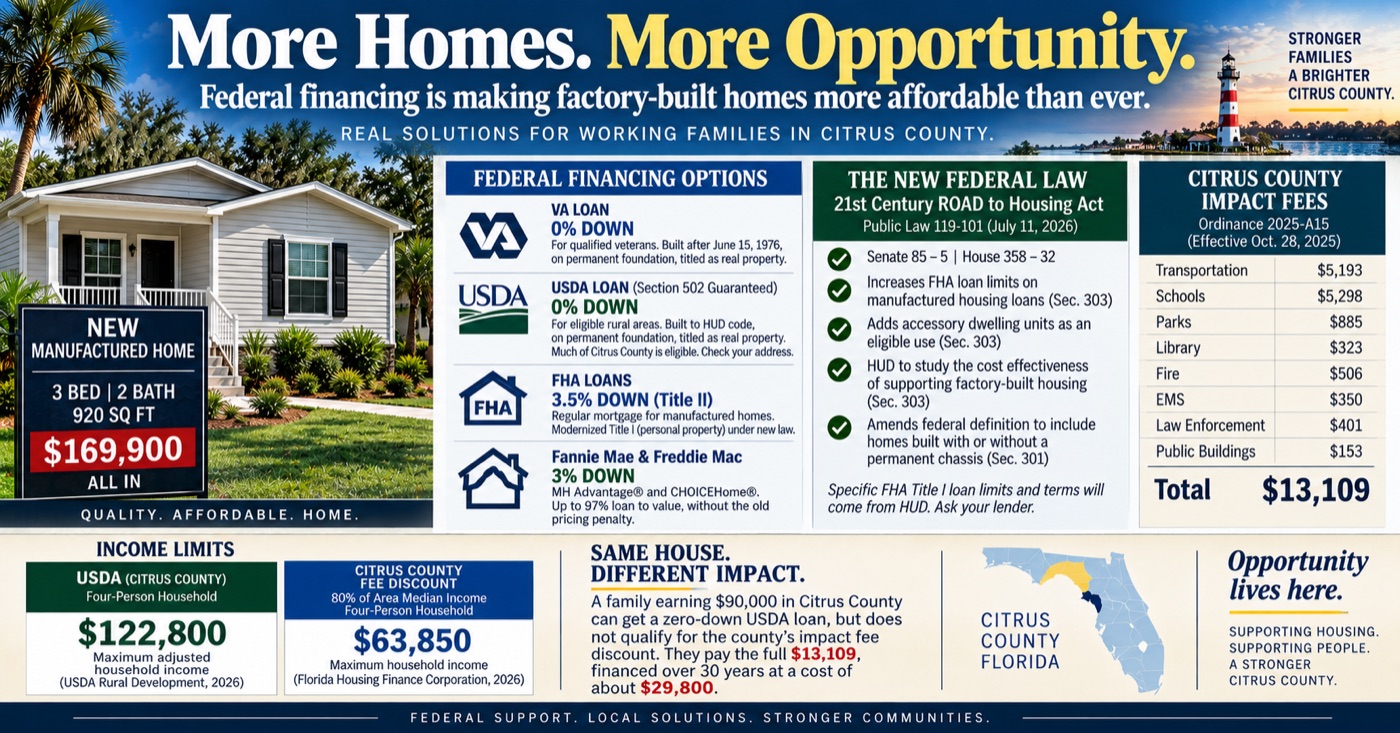
Start with the federal law, because it is new and it is large. The 21st Century ROAD to Housing Act became Public Law 119-101 on July 11 of this year. It cleared the Senate 85 to 5 and the House 358 to 32, which is not a margin you see often on anything. Title III is called Manufactured Housing for America and it runs to four sections.
Section 303 is the one that matters to a buyer. It increases the loan limits on FHA-insured manufactured housing loans, adds accessory dwelling units as an eligible use of that financing, and directs HUD to study the cost effectiveness of supporting factory-built housing. You will see specific dollar figures and loan terms quoted around this provision. I am not going to repeat them, because the section-by-section summary does not contain them and two sources I checked contradicted each other on the maximum term. The direction is not in doubt. The precise numbers will come from HUD, and until they do, ask your lender rather than a blog.
Section 301 deserves a note because it is being misreported. It amends the federal definition of manufactured home to include housing built, in the statute's words, with or without a permanent chassis. That is a widening of the category, not the abolition of the chassis. Nothing in it touches Florida's definitions. A mobile home under section 320.01 is still built on an integral chassis, and permanently affixed under section 193.075 still means tied down and connected to the normal and usual utilities. If somebody tells you the federal government just did away with the chassis, they have read a headline.
Now the part that actually moves people into houses.
If you are a veteran, the VA will finance a manufactured home at zero down. The conditions are specific: built on or after June 15, 1976, carrying its HUD certification label and data plate, on a permanent foundation meeting HUD and local code, and titled as real property on land you own. That last condition is the one that catches people, and it is the same real property test I wrote about last month.
If you are not a veteran, USDA will do the same thing. The Section 502 Guaranteed program finances a new manufactured home at zero down, permanently affixed, built to HUD code, in an eligible rural area.
Which raises the question everyone asks next. Does Citrus County count as rural?
I checked it on USDA's own property eligibility map rather than taking anyone's word. Entering Homosassa, 34446, returns this: "This address IS located in an eligible area."
So yes. Not a lender's marketing claim, USDA's own map.
Then there is the income question, and here is where most people's assumptions are simply wrong. They hear zero down and rural and assume the programme is aimed at the very poor. I ran the determination on USDA's own tool for Citrus County, which sits in the Homosassa Springs metropolitan area, for a household of four, under the guidelines in effect this week.
The maximum adjusted household income is $122,800.
That is not a poverty programme. That is two working adults with decent jobs. A paramedic married to a teacher. A deputy married to a nurse. Those households are comfortably inside a zero-down federal loan programme and most of them have no idea.
If neither of those fits, the conventional market has moved too. Fannie Mae's MH Advantage and Freddie Mac's CHOICEHome will do a manufactured home at three percent down, up to ninety-seven percent loan to value, without the pricing penalty these homes used to carry. FHA's Title II route is a regular mortgage at three and a half percent down. And FHA Title I, the personal property loan for a home without the land, is the piece the ROAD Act just modernised.
Put it together and the picture is unrecognisable from ten years ago. A new three bedroom, two bath home, titled as real property, at around $169,900, financed at zero down by a family earning well under the federal ceiling.
Now set that beside the county.
Citrus County offers a reduced impact fee for low-income housing, $9,310 instead of $13,109. To qualify, the household has to be at or below eighty percent of area median income. For a family of four in Citrus County, that is $63,850.
So the federal government will underwrite this family's mortgage at zero down up to $122,800 of household income. The county's help with the fee stops at $63,850. The federal ceiling is just under twice the local one.
I am not saying the county should match the federal number. Reasonable people can argue about where a local subsidy ought to stop, and a county has a smaller purse and a harder set of tradeoffs than Washington does. But the gap is worth seeing plainly, because it tells you something about who is falling through.
The household earning $90,000 in Citrus County is not poor and is not rich. They can get the loan. They cannot get the fee relief. They are paying the full $13,109, financed across thirty years at a cost of about $28,000, on the cheapest new house available to them. That is the household we keep saying we are worried about losing, and it is the one sitting in the gap between the two programmes.
Washington has done its part of this. It passed a law with eighty-five Senate votes and opened the financing wider than it has been in a generation. What it cannot do is set an impact fee in Lecanto.
If you are shopping for one of these homes, the practical advice is short. Ask your lender about VA and USDA before you ask about anything else, check the specific parcel on the USDA map rather than assuming, and make sure the home will be titled as real property, because nearly every good loan in this list depends on it.
And if you sit on the board, the question is simpler. The federal government just decided these families are worth financing. The only remaining question is whether the county agrees.
Sources for verification
- 21st Century ROAD to Housing Act, H.R. 6644, Public Law 119-101, enacted 11 July 2026. Senate 85-5, House 358-32.
- House Financial Services Committee section-by-section summary of H.R. 6644, 23 June 2026, Title III, Manufactured Housing for America, sections 301 to 304.
- USDA Rural Development, Single Family Housing Guaranteed property eligibility map, checked 24 September 2026: Homosassa, Citrus County, FL 34446 returns “This address IS located in an eligible area.”
- USDA Rural Development, Single Family Housing income eligibility determination, Florida / Citrus County / Homosassa Springs FL MSA, four-person household, guidelines in effect 24 September 2026: maximum adjusted household income $122,800.
- Florida Housing Finance Corporation, SHIP and HHRP income limits effective 1 May 2026: Citrus County 80 percent limit for a four-person household, $63,850.
- Citrus County Impact Fee Schedule, Ordinance 2025-A15, effective 28 October 2025: Single-Family Detached $13,109; Single-Family, Low-Income $9,310.
- Fla. Stat. s. 320.01(2)(a) and s. 193.075(1).
- U.S. Department of Veterans Affairs manufactured home loan requirements; Fannie Mae MH Advantage; Freddie Mac CHOICEHome; FHA Title I and Title II.
The ROAD to Housing Act's specific FHA Title I loan limits and maximum terms are not stated in the House section-by-section summary, and secondary sources disagree on them. They are deliberately omitted here pending HUD guidance. USDA property eligibility is determined per parcel by Rural Development on a complete application; the map result above is for the Homosassa 34446 area, because the vacant lot itself has no deliverable address to geocode.